Overview
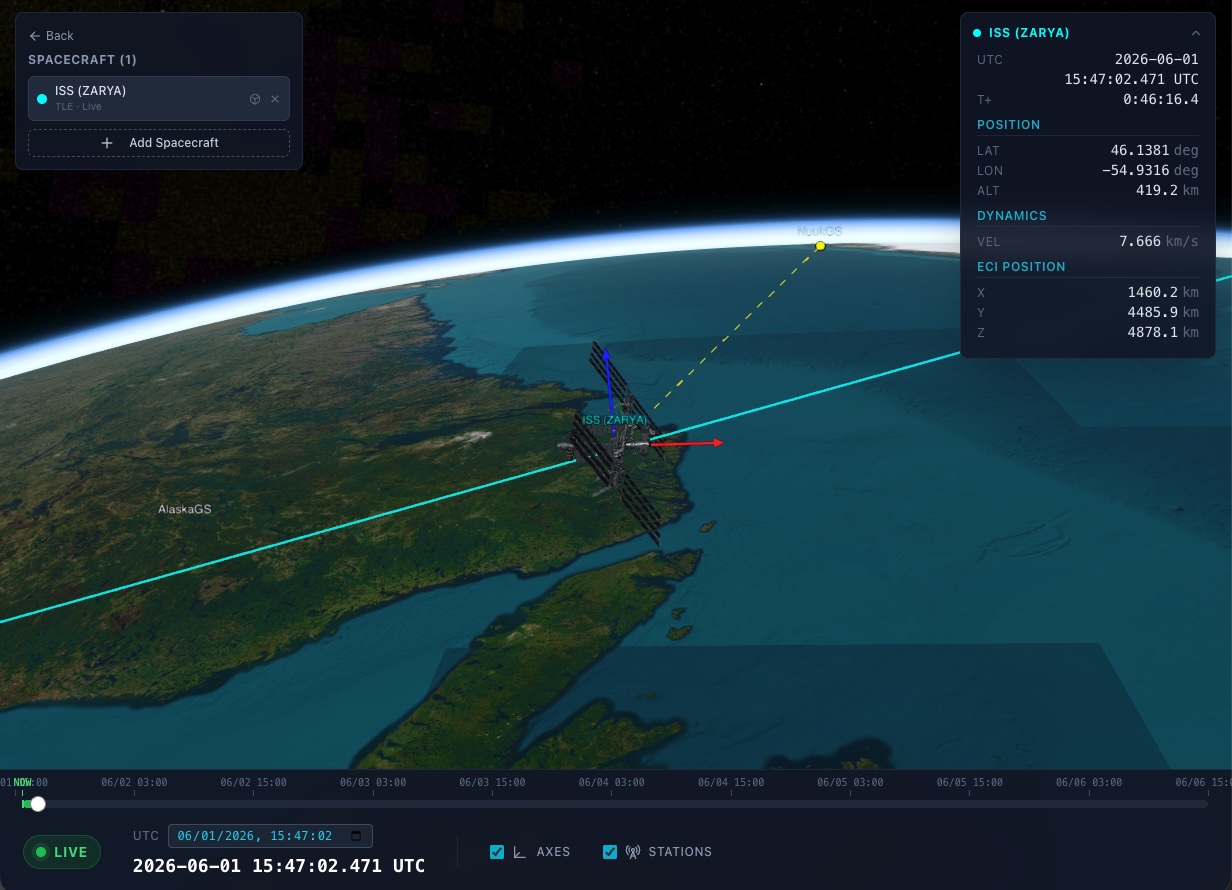
Prototype for live 3D satellite trajectory visualization using TLE data or GNC simulation outputs from private software — built for low-latency interaction and stable playback in a real-time data visualization workflow.
-
Problem
Smooth orbit playback with live telemetry overlays
-
Stage
Production prototype
-
Stack
Cesium · trajectory pipeline · Web APIs
Demo
Constraints
- Playback must stay smooth while scrubbing and during continuous orbit animation.
- Data sources vary: public TLE feeds or private GNC simulation outputs.
- Cesium callback properties and trail rendering are expensive at scale.
- Prototype environment with real operator expectations for responsiveness.
Pipeline
Ingestion & computation
- Full-stack trajectory computation from TLE or simulation exports.
- ECI to ECEF preprocessing to reduce per-frame coordinate conversion cost.
Playback & lookup
- Delta-time animation loops for stable frame pacing.
- O(log n) position lookup via binary search plus interpolation.
- Memoized Cesium callback properties to avoid redundant recomputation.
- Orbit trail windowing to cap geometry cost during long sessions.
Key decisions
Precompute what repeats
Coordinate transforms and trajectory samples are prepared ahead of playback so the render loop focuses on lookup and interpolation, not repeated astrodynamics work.
Bound trail geometry
Orbit trails use windowing rather than unbounded history, keeping GPU and memory use predictable during long simulation runs.
Optimize the hot path
Binary search on sorted time samples gives predictable lookup cost during scrubbing — the interaction pattern operators use most.
Screenshot
Outcome
- Delivered smooth, low-latency playback in a prototype environment.
- Unified pipeline for multiple data sources (TLE and private simulation output).
- Performance work targeted at real interaction patterns, not synthetic benchmarks.